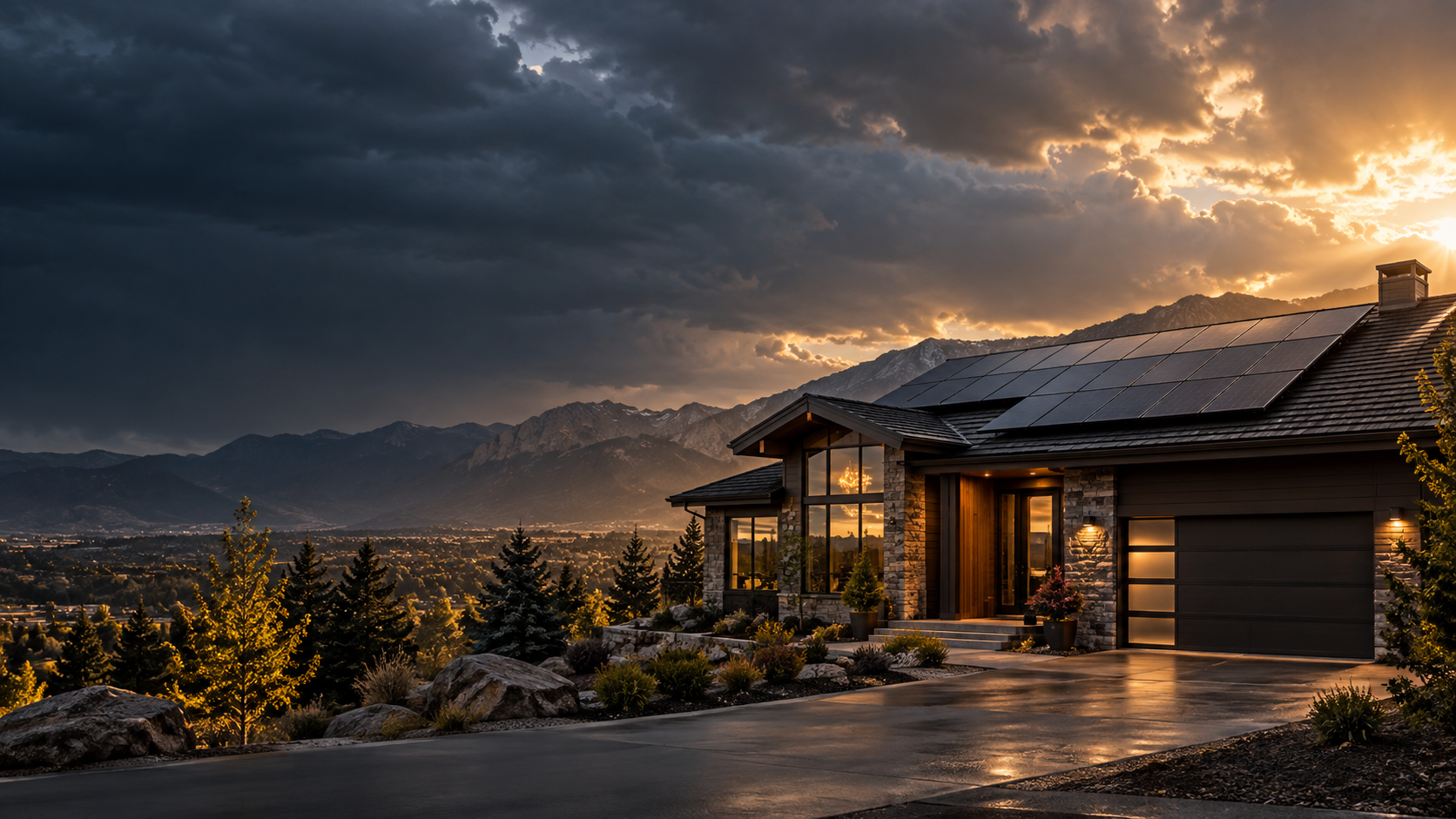
Illustration of a solar-powered mountain home at sunset

The homeowner’s guide to energy independence

Your forever home.
Your power.

The world feels unpredictable. Your home doesn’t have to.

Whether you’re preparing for the zombie apocalypse or just tired of renting your power, let’s explore what taking control could look like for you.

Solar. Battery backup. A realistic path toward independence.

More control. More peace of mind.

You chose a place to put down roots.
Build a power plan to match.

Gas prices. War. Uncertainty. You don’t have to predict what happens next to want more control over how your home runs.

If this is your forever home, it makes sense to look beyond the next utility bill. What would it take to produce more of your own electricity? Keep the refrigerator, lights and important equipment running during an outage? Or eventually live without an electric utility connection?

Those are different goals—and each deserves a different plan. Eclipse Solar can help you understand the tradeoffs before you choose equipment or make a commitment.

This guide focuses on electricity. Solar alone does not replace natural gas, propane, gasoline, water or sewer service. Reducing those dependencies requires separate decisions about your appliances, transportation and property.

01 / Choose your level of independence

“Cutting the cord” isn’t all or nothing.

Start with what you want your home to do. Then choose the system that supports it.

01

Produce your own

Solar + the grid

Generate electricity at home and buy from the utility when you need more. Exported energy may earn credits under your utility’s rules.

  • Best starting point when lowering purchased electricity is the main goal.
  • The grid covers nights and production shortfalls.
  • Standard grid-tied solar generally shuts down in an outage.

The tradeoffYou remain connected, with utility charges and changing rate rules.

03

Become your own utility

True off-grid living

Operate without an electric utility connection. Your generation, storage and backup plan must cover the home year-round.

  • Worth exploring for remote properties or a strong independence goal.
  • Requires careful winter and extended-outage planning.
  • May require a generator, fuel storage and deliberate load reduction.

The tradeoffYou take responsibility for shortfalls, maintenance and redundancy.

Backup depends on equipment that can safely isolate the home from the grid. DOE: rooftop solar during outages.

100% annual offset ≠ 24/7 independence.

A system can produce as much electricity as you use over a year and still depend on the utility after sunset or during a cloudy winter week. An annual bill comparison does not prove off-grid capability.

02 / Design around your life

What do you want to keep running?

“Back up my house” is the beginning of the conversation. The useful question is which equipment, for how long, and what needs to run at the same time.

Keep the essentials on

Refrigerator and freezer, selected lighting, phones, internet equipment and a few outlets. Add the well pump, sump pump or heating controls when the home depends on them.

Powered internet equipment still needs an available outside network. Critical medical equipment needs its own verified continuity plan.

Keep more of your routine

Add home-office equipment, more circuits and selected kitchen appliances. Manage high-demand loads so the system can prioritize what matters.

Plan for the big loads

Air conditioning, electric heat, water heating, well pumps, workshops and EV charging can change the design substantially. Motor starting surges matter as much as normal running demand.

Two numbers. Two different jobs.

kW is power: how much equipment the system can support at one time.

kWh is energy: how much electricity is stored or used over time.

A bigger energy reserve doesn’t automatically mean an inverter can start a large pump. A high-output inverter doesn’t automatically give you several days of stored energy.

National laboratory guide to battery power and capacity →

Illustrative runtime math

12 kWh ÷ 0.5 kW = 24 hours

If 12 kWh is actually available to deliver to household loads and those loads average 0.5 kW, that is about 24 hours without recharging. At a 2 kW average, it is about 6 hours.

These are arithmetic examples, not a system quote or backup guarantee. Real results depend on starting charge, reserve settings, losses, temperature, battery age and changing loads. Solar may extend runtime when conditions and equipment allow.

Ask for a written backup plan

It should identify the circuits included, equipment excluded, simultaneous-load limits, starting-surge capability, usable battery energy, reserve settings and expected runtime under stated assumptions.

03 / Plan for the difficult days

A sunny-day system is easy.
A winter-ready plan takes work.

Off-grid design needs to account for short days, shade, snow cover and periods with little useful solar production. Snow and ice can affect both energy production and the physical system. DOE’s winter-weather guidance explains why site conditions and equipment design matter.

For your home, ask for a month-by-month production estimate and a separate low-solar scenario. If the battery starts low and the next several days are cloudy, what happens?

A generator can add another layer of backup, but it introduces a fuel dependency. Fuel availability, storage, service intervals and compatibility belong in the plan. Combustion generators also require approved placement, ventilation and safe transfer equipment.

Your extended-outage plan should answer:

  1. What runs during the first night?
  2. What changes after a day with little solar?
  3. When are discretionary loads turned off?
  4. How is the battery recharged if the weather doesn’t improve?
  5. What happens if an inverter or battery needs service?

No system can promise unlimited power under every condition. Design for a defined scenario and know the limits.

Solar with compatible storage can provide local power when the wider grid is disrupted. DOE: solar and resilience basics.

04 / Look at the whole home

The best system starts before the panels.

Use less first

Review insulation, air leaks, heating and cooling, and inefficient appliances. A smaller energy requirement can make the solar and storage plan more manageable.

Check the roof and site

Roof life, structure, shade, orientation, usable area and ground-mount space all affect the options. Coordinate roof work before installing equipment that may later need removal.

Plan future electricity use

An EV, heat pump, electric water heater, workshop or addition can change demand. Replacing gas appliances requires a new electrical-load and winter-heating assessment.

Review equipment and placement

Existing solar, service capacity, inverter compatibility, battery temperature limits, clearances and access for maintenance need to be checked together.

More on solar suitability and ownership: DOE’s Homeowner’s Guide to Solar.

Can I legally disconnect from the utility?

That must be checked for your specific address. Local building and electrical requirements, utility service rules, and any property or financing restrictions can affect the project. Ask about permits, inspections, interconnection or disconnection requirements, and any ongoing fees before committing. An approved backup system is not automatically an approved off-grid home.

05 / Understand the investment

Own your power.
Know the full cost.

Sunlight doesn’t send a bill. Equipment, financing and upkeep still cost money. Compare the full ownership picture against the utility electricity you expect to avoid buying.

What changes the price?

  • Solar size, roof complexity and mounting approach
  • Battery energy capacity and inverter output
  • Backup circuits, load controls and electrical upgrades
  • Permits, engineering, trenching and installation access
  • Generator integration and site-specific work
  • Existing equipment that can be reused—or must be replaced

A reference point, not an Eclipse quote

Why generic price tags fall short

DOE’s 2025 first-quarter model puts a representative 8 kW residential rooftop solar system at about $23,600, and the same solar size with 13.5 kWh of storage at about $36,720, using modeled market prices in 2024 dollars, before owner incentives.

Those are national benchmark designs—not current local bids, whole-home backup promises or off-grid budgets. A different roof, larger battery bank, service upgrade or generator can change the cost substantially.

See DOE’s benchmark scope and assumptions →
Compare proposals on the same terms
Look beyondAsk to see
The monthly paymentCash price, financed price, APR, fees, term and total payments. With a lease or power purchase agreement, confirm who owns the equipment and what happens when you sell.
A projected $0 utility billRemaining fixed charges, purchased electricity, export-credit rules and assumptions about future rate increases.
The equipment warrantyCoverage for labor, travel and replacement; capacity-retention terms; exclusions; and who actually handles service.
A simple payback claimMaintenance, insurance effects, equipment replacement, financing and conservative production assumptions over your planned ownership period.
The biggest systemA comparison of essential backup, broader backup and off-grid design against the same household priorities.

The value of backup power is personal. Protecting food, working from home or maintaining essential equipment may matter even when the battery’s bill savings alone do not justify its cost.

06 / The forever-home check

Does this fit the life you’re building?

Good reasons to explore it

  • You expect to stay and can plan around long-term ownership.
  • You want less exposure to purchased electricity and utility rate changes.
  • You have specific equipment you want supported in an outage.
  • You have suitable space for solar and storage.
  • You are willing to prioritize loads when conditions require it.

Reasons to slow down and solve the basics

  • Your roof needs work or the site has substantial shade.
  • The proposed payment only works with optimistic savings.
  • Your must-run equipment is not included in the backup design.
  • You expect unlimited off-grid power without maintenance or lifestyle changes.
  • Your installation, permitting or disconnection path is unclear.
You can build toward independence in stages.

Start with efficiency and a site assessment. Evaluate solar, then compatible storage and backup controls. If expansion is the goal, plan capacity, wiring and equipment compatibility from the beginning—future additions are not automatically plug-and-play.

07 / Start with a conversation

Let’s help you make the decision.

You don’t need to know how many panels or batteries you need. Bring the goals. We’ll help work through the details.

01

Tell us what matters

Lower purchased electricity, overnight backup, extended outages or full off-grid operation. Share what you want protected and your comfort level with managing loads.

02

Evaluate the home

Review energy use, the roof and site, existing equipment, major loads, future upgrades and local project requirements.

03

Compare practical options

Discuss the system scope, expected performance, backup limits, installed cost and ownership responsibilities before deciding what fits.

Helpful to have for the first conversation

Your address and utility provider • 12 months of electric bills or usage data • existing solar and battery details • must-run appliances • future EV or heating plans • your budget and desired timing.

If you don’t have everything yet, start with what you know.

Straight answers

Questions worth asking.

Will solar panels keep my lights on in an outage?

Standard grid-tied solar generally will not. Outage operation requires equipment designed to isolate from the utility and power household loads safely. A compatible solar-and-battery backup system can provide that function within its design limits. Some specialized systems offer limited daylight backup; that still is not overnight storage.

Do I have to disconnect to become more independent?

No. You can generate more of your own electricity, add storage and protect selected loads while keeping your utility connection. That may meet your goals without taking on every responsibility of a full off-grid system.

Can I run air conditioning, electric heat or charge my EV?

Possibly, if those loads are included in the design. They can require substantially more generation, storage and inverter capacity. We need to evaluate the equipment, starting demand and how many loads will run together. During a prolonged outage, limiting or postponing these uses can preserve energy for essentials.

Can you add batteries to the solar I already have?

Often, yes. We first need to review the existing inverter, wiring, service equipment, monitoring and proposed battery platform. Some systems can be expanded; others need changes before they can support backup operation.

Will I still have an electric bill?

If you remain connected, you may still pay fixed service charges and for energy you import. Export credits and billing rules vary by utility. True off-grid operation removes electric utility purchases, but it does not remove equipment, maintenance, replacement or possible generator-fuel costs.

What happens if the battery runs out?

While grid-connected, the utility can supply power when available. During an outage or off-grid operation, loads may shut down unless solar or another compatible source can support them. Ask how the proposed system recovers from a low-charge shutdown and whether restarting solar needs a battery reserve or other power source.

Is a generator enough?

For some outage goals, a generator may be worth comparing. It uses fuel and needs maintenance. Solar and storage provide a different way to supply energy, and a professionally designed combination can add redundancy. The right choice depends on outage duration, loads, fuel access, installation conditions and budget.

What happens when equipment gets older?

Expect to monitor performance, maintain the system and plan for eventual component replacement. Review battery capacity-retention terms, inverter and workmanship coverage, service availability and what is excluded. A long warranty is not the same as zero upkeep or unchanged performance.

Do you install systems outside Colorado?

Eclipse Solar also lists service areas in Indiana, Missouri, Kentucky, Illinois and Kansas. Contact us with your address and the type of project so we can confirm availability and local requirements.

Okay, but what about the zombie apocalypse?

We can help plan for power outages. Zombies are outside the warranty. The practical version is simple: define your essentials, know your system’s limits and have a plan for the days when conditions are less than ideal.
Eclipse Solar LLC

Your home.
Your priorities.
Your next step.

You’ve invested in a place to call your own. Let’s find out what it would take to make more of the power yours, too.

Whether you want a little more security or you’re serious about cutting the cord, we’ll help you explore a realistic path.

Prefer to start by email? Include your property address and what you’d like to keep running.